The Symphony of Stone and Living Greenery
While the Loire Valley is celebrated for royal castles, Château de Villandry is renowned across the globe for something far rarer: six hectares of the most spectacular, mathematically precise Renaissance terraced gardens in existence. Situated at the confluence of the Cher and Loire rivers fifteen kilometers west of Tours, Villandry is the final great stone château built on the banks of the royal river during the French Renaissance.
The estate was constructed in 1536 by Jean Le Breton, King François I's Minister of Finance and supervisor of works at Chambord. Having served as ambassador to Rome, Le Breton stripped away an ancient medieval feudal fortress (leaving only the 12th-century stone keep where King Philip Augustus of France once signed the Treaty of Colombiers with Henry II of England) to erect a clean, three-winged palace with classical mullioned windows, slate roofs, and open arcaded loggias.
The Visionary Resurrection by Joachim Carvallo
By the late 19th century, Villandry's Renaissance splendors had almost vanished. A succession of owners had ripped out the formal parterres to plant a fashionable English romantic park with wandering paths and grassy mounds. The estate had fallen into dereliction and was slated for demolition.
In 1906, the property was purchased by Dr. Joachim Carvallo, a brilliant Spanish medical researcher working under Nobel laureate Charles Richet in Paris, and his wife Ann Coleman, an American heiress from a Pennsylvania iron family. Carvallo abandoned his medical career to dedicate the rest of his life to restoring Villandry.
Relying on archaeological excavations that uncovered the buried 16th-century stone foundations, and studying the monumental 1576 architectural treaties of Jacques Androuet du Cerceau (*Les plus excellents bastiments de France*), Carvallo painstakingly reconstructed the lost Renaissance terraced gardens. Today, the estate remains entirely in the hands of the Carvallo family, who continue to manage the property with passionate stewardship.
Combine Villandry Gardens with Vouvray Wine Tasting
Villandry sits west of Tours, while the premier Vouvray wine caves lie east. A coordinated small-group minivan excursion solves rural transit, combining garden strolls with cellar visits and private estate lunches.
The Six Thematic Garden Terraces Explained
Villandry is designed across three distinct ascending landscape terraces stepped into the river valley hillside:
1. The Decorative Vegetable Garden (*Le Potager Décoratif*)
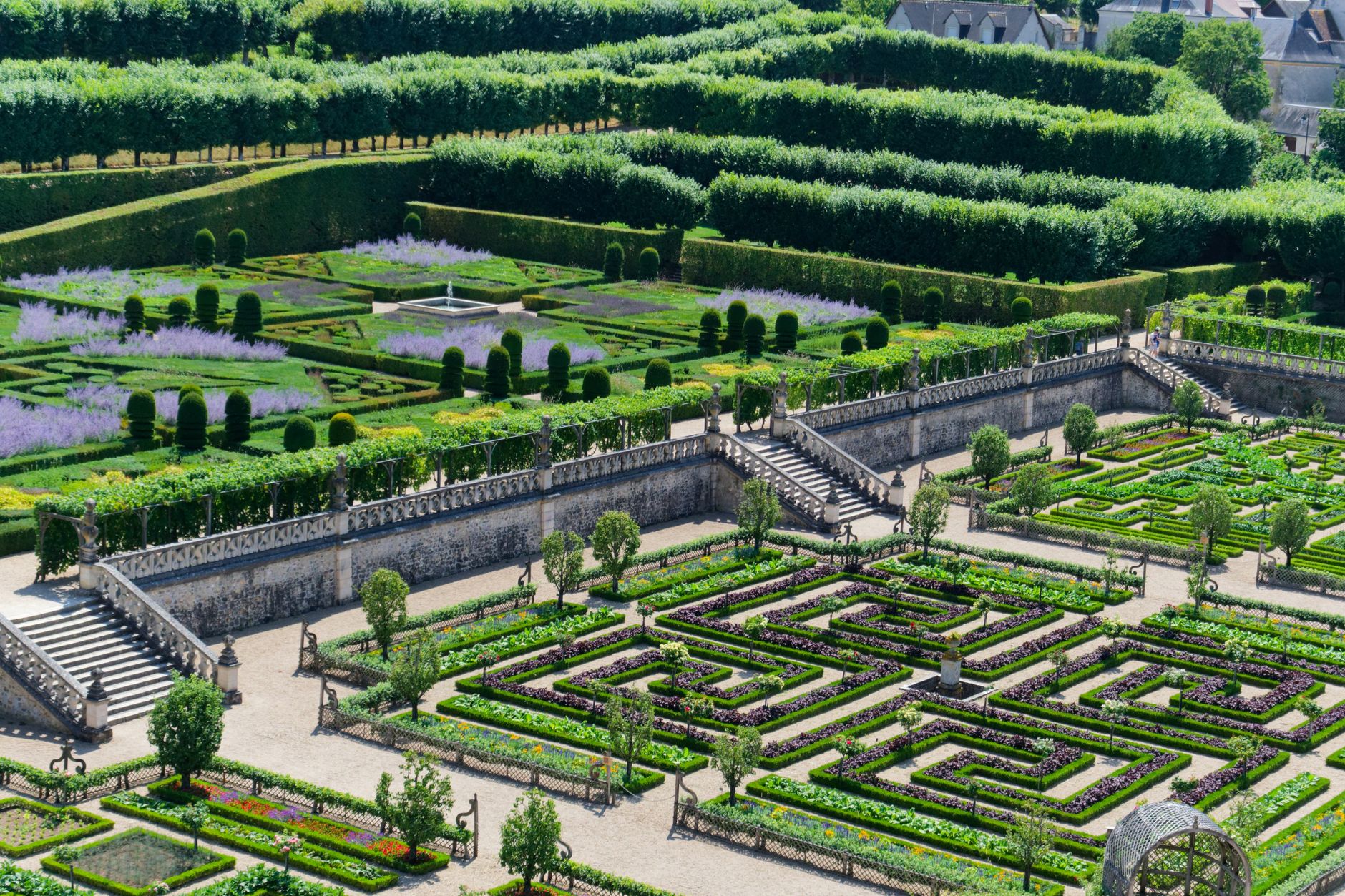
Occupying the lowest terrace between the castle and the village, this is the most famous kitchen garden in Europe. Laid out in nine immense square plots, it combines traditional monastic geometry with Italian decorative planting. Over forty species of vegetables are selected not only for their culinary qualities, but for the architectural color harmony of their foliage - from ruby-red curled cabbage and bluish leeks to purple basil, golden pumpkins, and feathered carrot fronds.
Every year, Villandry's team of ten full-time gardeners plant over 115,000 individual vegetable and flower seedlings by hand in two seasonal rotations (spring and summer). Since 2009, the gardens have been farmed 100% organically without synthetic chemical pesticides or fertilizers, relying entirely on natural ladybug pest control and organic compost.
2. The Ornamental Salon of Love (*Le Jardin d'Ornement*)
Perched directly above the vegetable garden, four clipped boxwood squares tell the allegorical story of human romance, designed to be admired looking down from the castle windows:
- Tender Love (L'Amour tendre): Boxwood formed into hearts, flames, and delicate masked-ball fans.
- Passionate Love (L'Amour passionné): Hearts broken by passion, arranged in an intense labyrinth of clipped hedges.
- Fickle Love (L'Amour volage): Four corner yellow butterfly fans symbolizing betrayal, deception, and transient desire.
- Tragic Love (L'Amour tragique): Dagger blades and rapier swords forming sharp corners where rivals fought duels over court ladies.
3. The Water Garden (*Le Jardin d'Eau*)
Set on the highest terrace, the serene Water Garden is framed around an enormous mirror-like pool shaped in the outline of a Louis XV cavalry breastplate. Fed by the natural waters of the Bec stream, the pool provides water pressure for the fountains and supplies irrigation for the thousands of plants on the lower terraces.
4. The Sun Garden, Herb Garden and Labyrinth
The estate also features the Sun Garden (planted with warm yellow, orange, and golden perennials surrounding an eight-pointed star pool), the Herb Garden (growing thirty traditional medieval medicinal and aromatic plants), and a peaceful hornbeam hedge maze where visitors can lose themselves among shaded corridors.
The Castle Interior and the Spanish Mudéjar Ceiling
While the gardens are the primary draw, the castle interior contains several remarkable rooms. The undisputed artistic treasure is the Moorish Ceiling (*Plafond mudéjar*) in the oriental salon.
Carved in the 15th century from cedar and gilded pine by Islamic craftsmen for the palace of the Counts of Maqueda in Toledo, Spain, the palace was dismantled in 1905. Joachim Carvallo purchased the ceiling at auction, transporting the 3,600 interlocking wooden components to Villandry and spending nearly a year reconstructing the intricate geometric stalactite dome (*mocárabes*). The castle also displays Carvallo's collection of Old Spanish master paintings, including works by Francisco de Zurbarán and the school of Velázquez.
Red Flags and Mistakes to Avoid at Villandry
Direct Choice Visitor FAQ
Yes, Villandry offers a "Gardens Only" ticket (roughly €8.00) alongside the full "Castle & Gardens" ticket (from €13.00). If you have limited time and have already visited furnished châteaux like Chenonceau or Blois, the Gardens Only pass gives you complete access to all six terraces, the maze, and the belvedere overlook.
Budget a minimum of 2.5 to 3 hours. Walking through all six garden terraces at a relaxed pace takes about 1.5 to 2 hours, and exploring the castle interior and Spanish ceiling requires another 45 minutes.
Small dogs held in hand or inside transport bags are permitted inside both the castle and gardens. Larger dogs on leashes are permitted only within the outdoor gardens, but are strictly prohibited inside the castle rooms.
Why Book Your Tickets & Excursions Online in Advance?
While purchasing tickets on-site was standard in past years, the Loire Valley châteaux now enforce strict hourly visitor caps to protect historic interiors. High-demand hours (10:30–14:30) and weekends frequently sell out days ahead. Here are the key advantages of booking digital priority passes online:
Château de Villandry Tickets, Garden Tours & Wine Tastings
Digital priority admission to the world's premier Renaissance ornamental gardens, combined with Vouvray wine lunches.
Château de Villandry: Palace & World-Famous Renaissance Gardens Ticket
- Entry from €8.50 (Gardens Only) or €13.50 (Château & Gardens combined)
- Instant digital ticket bypassing garden and castle ticket counters
- Marvel at the internationally acclaimed multi-tiered decorative vegetable garden (Potager)
- Explore the ornamental Love Garden, Water Garden, and Sun Garden labyrinths
Villandry Gardens & Azay-le-Rideau: Afternoon Tour from Tours
- Half-day relaxing afternoon departure from central Tours
- Skip-the-line access to Villandry's geometric Renaissance garden terraces
- Visit the enchanting water-reflected Château d'Azay-le-Rideau
- Air-conditioned minivan transport with expert English-speaking guide
Villandry Gardens & Vouvray Wine Tour with Private Château Lunch (from Amboise)
- Visit Villandry's world-famous ornamental garden terraces with guide
- Enjoy a private multi-course gourmet lunch hosted inside a private family château
- Tour authentic Vouvray troglodyte chalk cellars and taste fine Chenin Blanc vintages
- Small group limited to 8 passengers in premium Mercedes minivan
Villandry Gardens & Vouvray Wine Tour with Private Château Lunch (from Tours)
- Depart directly from central Tours in comfortable minivan
- Guided walk through Villandry's 6 distinct Renaissance garden terraces
- Exclusive private castle lunch with fine estate wines
- Cellar master tasting of dry, demi-sec, and sparkling Vouvray wines