Four Centuries, Four Dynasties, One Royal Courtyard
If you want to understand the rapid architectural transformation of France from feudal darkness to the elegance of the Renaissance, Château de Blois is the ultimate open-air textbook. Perched on a limestone promontory overlooking the Loire river and the slate roofs of the old town, Blois served as the primary residence for seven French kings and ten queens between 1498 and 1643.
Unlike most royal estates built in a single unified campaign, Blois surrounds its cobblestone court with four distinct architectural wings, each commissioned by a different ruler from a different historical era. Standing in the center of the courtyard, a single 360-degree turn reveals eight hundred years of French building evolution.
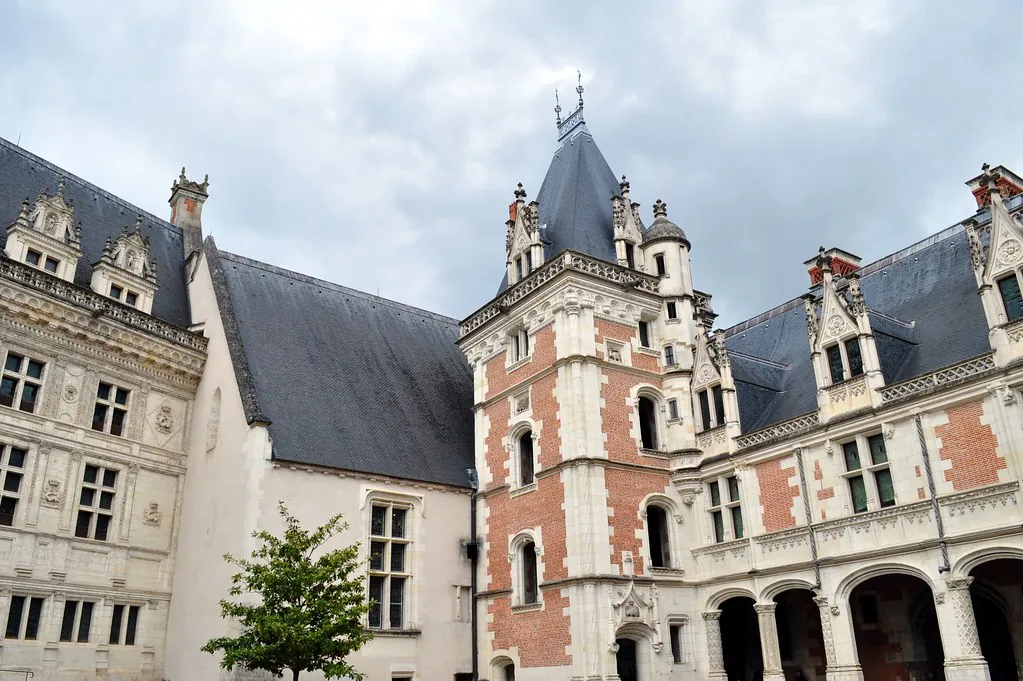
The Four Architectural Wings Explained
Begin on the north side with the Medieval Fortress Wing (13th Century). This brooding limestone structure contains the *Salle des États Généraux*, built in 1214. It is the largest and oldest preserved civil Gothic hall in France, with its double-nave timber roof supported by painted cylindrical pillars and decorated with gold fleur-de-lis motifs. It was here that Joan of Arc arrived in April 1429 to have her military banner blessed by the Archbishop of Reims before marching to relieve the Siege of Orléans.
Turn to the east facade for the Louis XII Wing (1498–1501). Marking the transition from Flamboyant Gothic to the early Renaissance, it features warm red brick patterned with dark lozenges and white tuffeau limestone trim. Above the main entrance arch stands a stone equestrian statue of King Louis XII himself, accompanied by his personal royal badge: the porcupine, bearing the combative Latin motto Qui s'y frotte, s'y pique ("Whoever touches me pricks himself").
The north wing is the François I Renaissance Wing (1515–1520). Fresh from his Italian campaigns, the young king introduced Italian Renaissance decorative motifs, carving delicate acanthus leaves, classical pilasters, and his salamander emblems across the facade. The undisputed centerpiece is the monumental octagonal exterior staircase. Projecting forward into the courtyard like a limestone tower, three of its eight sides are open to the air. In the 16th century, courtiers treated this staircase as an open-air theater stage, showing off elaborate Italian silks and court fashions as they ascended between royal levels.
Finally, the west side holds the Gaston d'Orléans Classical Wing (1635–1638). Commissioned by the rebellious brother of King Louis XIII and designed by premier French architect François Mansart, it introduced monumental Neoclassicism to the Loire Valley with austere Doric, Ionic, and Corinthian column orders, crowned by a majestic domed staircase.
Exploring Blois and Neighboring Castles Without a Car?
Blois is the primary transit gateway of the central Loire Valley. Direct TER trains run hourly from Paris Austerlitz (1h 25m). From Blois station forecourt, the seasonal Navette Châteaux shuttle connects directly to Chambord and Cheverny from April to November.
The Royal Murder: Assassination of the Duke of Guise
Behind the ornate facades of Blois lies the scene of one of the bloodiest political murders in European history. In the winter of 1588, France was consumed by the Wars of Religion. The weak Valois monarch, King Henri III, found himself politically cornered by the ultra-Catholic League, led by the towering, charismatic Henri I, Duke of Guise (known as Le Balafré due to a battle scar across his cheek).
Feeling his royal authority slipping away, King Henri III summoned the Estates General to meet at Blois. On the freezing morning of December 23, 1588, the king summoned Guise to his private second-floor council chamber under the pretext of royal business. As the Duke stepped through the door leading to the royal bedchamber, eight members of the king's personal Gascon bodyguard unit, known as "The Forty-Five" (*Les Quarante-Cinq*), drew concealed daggers and rapiers.
Guise fought fiercely despite being unarmed, dragging several assassins across the floor before collapsing at the foot of the royal bed. Henri III emerged from behind a heavy velvet wall hanging, reportedly kicking the dying nobleman's face and declaring: "Mon Dieu, he is even taller dead than alive!" The Duke's brother, the Cardinal of Guise, was arrested and executed in the castle basement the following morning. Both bodies were burned to ash in the council room fireplace to prevent Catholic sympathizers from collecting relics, and the ashes were scattered into the Loire river.
Catherine de' Medici's Studiolo and Secret Cabinets
Just down the gallery from the murder scene sits the intimate private study (*Studiolo*) of the Queen Mother, Catherine de' Medici. It is the only royal Renaissance cabinet in France that has survived with its original 16th-century woodwork completely intact.
The room is lined with 237 finely carved wooden wall panels depicting foliage, grotesque masks, and Italian arabesques. Four of these panels conceal hidden spring-loaded wall cupboards activated by secret floor pedals. While popular folklore and Alexandre Dumas novels claimed Catherine stored lethal Italian poisons inside these secret compartments, archival inventories confirm they were used to store confidential diplomatic dispatches, state treaties, and the royal jewel collection. Catherine died in her adjoining bedchamber in January 1589, mere days after the Duke of Guise's murder, at the age of sixty-nine.
Sound and Light Spectacle (*Son et Lumière*)
If your itinerary allows you to stay overnight in Blois, do not miss the evening Sound and Light show hosted inside the castle courtyard between April and September. Using 360-degree video projection mapping and spatial surround sound against the four distinct historical facades, the show recreates the royal pageantry, castle fires, and the dramatic murder of the Duke of Guise. Narrated in French with high-fidelity English audio headsets available at the gate, it provides an unforgettable nighttime perspective on the palace.
Red Flags and Mistakes to Avoid at Blois
Direct Choice Visitor FAQ
Base yourself in Blois if traveling by train and prioritizing royal history and architecture; base yourself in Amboise for romantic riverside atmosphere, troglodyte wine cellars, and walking proximity to Leonardo da Vinci's home at Clos Lucé. Blois is a larger, working French departmental capital with better train connections to Chambord via the shuttle bus. Amboise is smaller, more touristic, and concentrates more castle hotels within walking distance.
Plan for 2 to 2.5 hours. You will need about 1.5 hours to tour the four wings, the François I staircase, the historical apartments, and Catherine de' Medici's study, plus 45 minutes to browse the Fine Arts Museum and take in the panoramic river terrace views overlooking Saint-Nicolas church.
No, the evening *Son et Lumière* requires a separate ticket or a combined daytime + evening pass. Combined passes can be booked online or at the ticket counter for a modest supplement of roughly €7.00. The courtyard gates reopen 30 minutes before nightfall.
Why Book Your Tickets & Excursions Online in Advance?
While purchasing tickets on-site was standard in past years, the Loire Valley châteaux now enforce strict hourly visitor caps to protect historic interiors. High-demand hours (10:30–14:30) and weekends frequently sell out days ahead. Here are the key advantages of booking digital priority passes online:
Royal Château de Blois Tickets & Historical Tours
Instant digital admission via Tiqets and expert storyteller walking tours through four royal architectural wings.
Royal Château de Blois: Priority Digital Entry Ticket
- Instant smartphone barcode entry — zero on-site box office waiting
- Discover four distinct architectural styles around one central courtyard
- Marvel at François I's octagonal open-air spiral staircase
- Visit the royal apartments of Catherine de' Medici and the Fine Arts Museum
Royal Castle of Blois: Historical Guided Walking Tour
- Expert guide recounting the dramatic assassination of the Duke of Guise
- In-depth analysis of Gothic, Flamboyant, Renaissance, and Classical wings
- Explore Catherine de' Medici's secret cabinets and poisoned drawer legends
- Panoramic views over the Loire river and Blois old town
Château de Blois: VIP Private Tour with Admission Tickets Included
- Strictly private guide exclusively dedicated to your party
- All admission tickets and priority access included
- Tailored historical pacing tailored to your interests and family needs
- Unrestricted access to discuss architectural nuances with expert
Small-Group Royal Trio Day Tour: Chambord, Blois & Cheverny
- Visit three major royal estates in one coordinated day
- Chambord's grand colossus + Blois royal intrigue + Cheverny classical elegance
- Witness the famous feeding of Cheverny's 100 hunting hounds
- Local wine tasting in Cheverny AOC included