The Ladies' Castle: Six Centuries of Female Influence
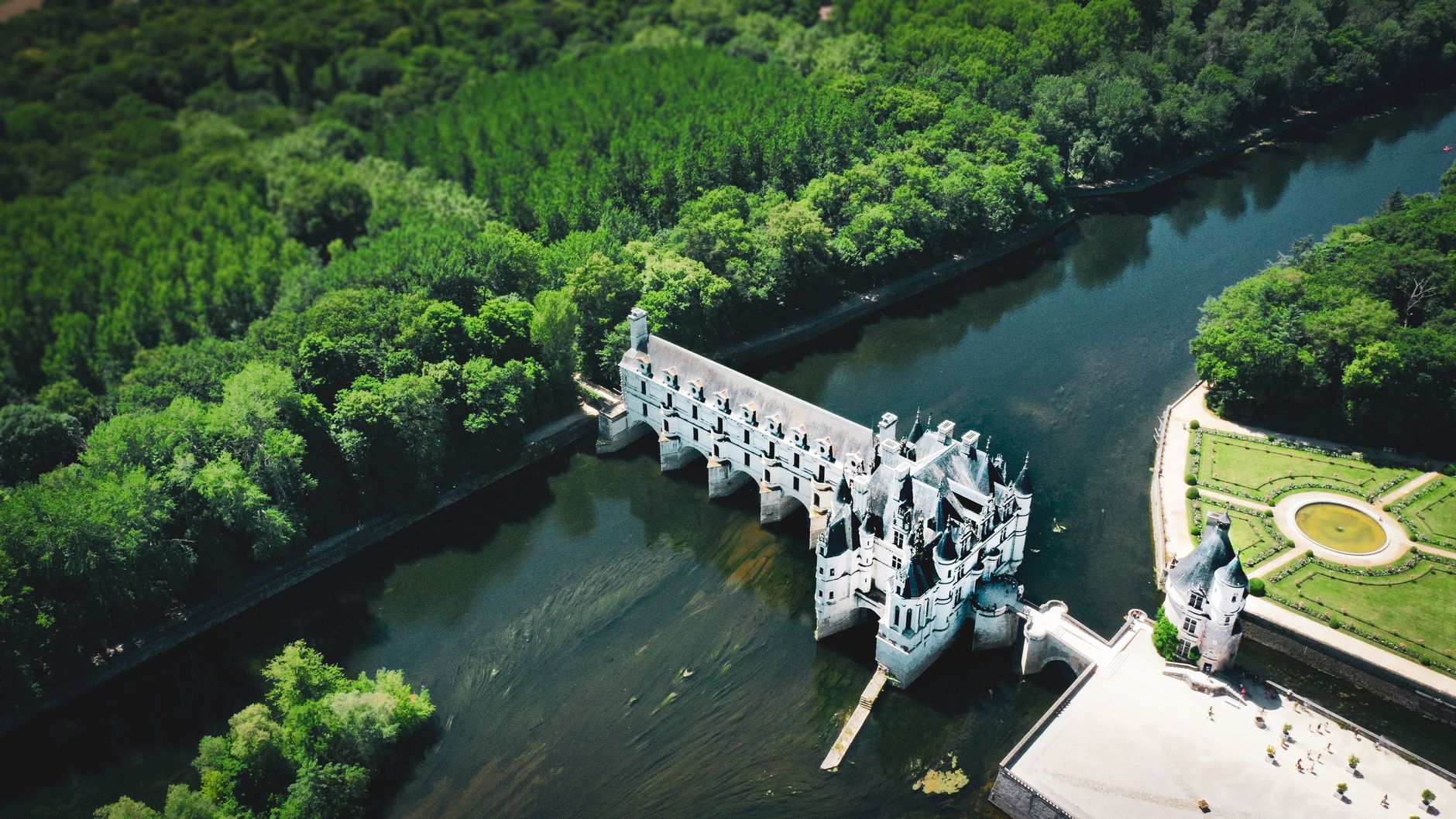
Unlike Chambord's masculine military scale, Château de Chenonceau owes its architecture, decor, and survival to an unbroken lineage of remarkable women. Known across France as Le Château des Dames, it spans the quiet waters of the River Cher like an arched white stone bridge, surrounded by manicured French gardens, centuries-old plane trees, and water meadows.
The original Renaissance structure was built between 1513 and 1521 by Katherine Briçonnet, wife of royal tax collector Thomas Bohier. While Bohier served King François I in Italy, Katherine supervised construction daily. Breaking with the medieval French tradition of dark spiral staircases tucked into stone turrets, she designed a straight, wide Italian-style staircase (*escalier droit*) that ascends through the center of the house, allowing court gowns and guests to glide between floors effortlessly.
The Royal Rivalry: Diane de Poitiers vs. Catherine de' Medici
When King Henri II inherited the throne in 1547, he gifted Chenonceau to his glamorous mistress, Diane de Poitiers, who was twenty years his senior. Diane commissioned royal architect Philibert de l'Orme to build a stone bridge across the Cher, allowing access to the hunting forests on the southern riverbank. She also laid out a sweeping 12,000-square-meter formal parterre garden elevated on stone buttresses to resist river floods, planting white roses, fruit orchards, and lavender.
When Henri II died from a jousting wound in 1559, his vengeful widow, Queen Catherine de' Medici, acted quickly. She forced Diane to hand over Chenonceau in exchange for the brooding fortress of Chaumont-sur-Loire. Catherine made Chenonceau her personal seat of power. She commissioned architect Jean Bullant to build a two-storey Grand Gallery atop Diane's bridge, inspired by the covered Ponte Vecchio in her native Florence.
In this 60-meter gallery, with its black-and-white slate checkerboard floor and eighteen arched windows looking down upon the Cher, Catherine hosted lavish political summits. In 1560, she orchestrated France's very first fireworks display here to celebrate the accession of her son, King François II, and his young Scottish bride, Mary Stuart (Mary, Queen of Scots).
Combine Chenonceau & Chambord in a Single Day?
Trying to coordinate rural trains and buses between Chenonceau (on the Cher river) and Chambord (in the Sologne forest) without a car consumes 4+ hours in connections. The most sensible option is an organized day tour with pre-booked castle tickets and round-trip transport.
The Sorrow of Louise of Lorraine and Enlightenment Rescue
Following the assassination of King Henri III in 1589, his widow Louise of Lorraine retreated to Chenonceau in deep mourning. She converted her bedchamber on the second floor into a somber, monastic cell. She painted the walls black and decorated the moldings with painted silver teardrops, severed feathers, and gravediggers' spades. Louise lived here in total silence for eleven years, attended by Capuchin nuns, walking through the chilly galleries in white mourning robes until her death in 1601.
In the 18th century, Chenonceau was acquired by Madame Louise Dupin, a brilliant patron of the French Enlightenment. Her literary salon drew thinkers like Voltaire, Montesquieu, and Jean-Jacques Rousseau, who lived at Chenonceau for months as tutor to her son. When the French Revolution erupted in 1789 and revolutionary mobs set fire to neighboring royal estates, Madame Dupin saved Chenonceau by reminding the Revolutionary Committee that the bridge was the only river crossing for local villagers over a stretch of twenty miles.
Wartime Hospital and the Resistance Escape Route
Chenonceau's unique geography turned it into a crucial crossing point during both world wars. During World War I, the estate's owners, the Menier chocolate family, funded a 120-bed military surgical hospital inside the Grand Gallery at their own expense. Between 1914 and 1918, more than 2,250 wounded French soldiers were treated here, with medical teams utilizing one of the earliest battlefield X-ray units.
During the Nazi occupation of France from 1940 to 1942, the River Cher marked the strict demarcation line between German-occupied northern France and the unoccupied Vichy zone. The entrance to the castle sat in the German-controlled zone, while the south door of the Grand Gallery opened onto the free bank. The Menier family and local Resistance fighters used the gallery as an escape conduit, smuggling thousands of Allied airmen, escaped prisoners, and Jewish families across the river under cover of darkness.
The Living Castle: Historic Floristry and Interior Highlights
Unlike many hollowed-out Loire estates, Chenonceau remains completely furnished with authentic Period pieces, tapestries, and Old Master canvases. The art collection includes major works by Murillo, Tintoretto, Rubens, Nicolas Poussin, and Correggio.
Make sure to explore the Renaissance kitchens housed in the massive stone piers supporting the castle above the Cher. You can see the original spit-roasting hearths, gleaming copper pans, bread baking ovens, and the supply hatch where river barges delivered provisions directly into the larder.
Chenonceau is also the only monument in France with its own permanent floral workshop (*Atelier Floral*). Led by Meilleur Ouvrier de France florists, the team uses flowers grown in the estate's private potager to create fresh, bespoke arrangements for every bedchamber, gallery, and salon twice every week.
Red Flags and Mistakes to Avoid at Chenonceau
Direct Choice Visitor FAQ
Take the regional TER train from Tours station directly to the dedicated Chisseaux-Chenonceaux halt. The journey takes 25 minutes, and trains run roughly 6 to 8 times daily. The castle entrance gate is located just 400 meters (a 5-minute flat walk) from the railway platform, making Chenonceau the easiest castle in the valley to visit independently by train.
Yes, kayak and canoe rentals operate from May to September at the base in neighboring Chisseaux (approx. 2 km upstream) or at Montrichard. Paddling directly under the monumental arches of Chenonceau offers the most spectacular, crowd-free photo angle in the entire Loire Valley.
The ground floor (including the guard room, chapel, and the Grand Gallery across the Cher) is fully accessible via ramps, and the exterior formal gardens have packed gravel paths suitable for wheelchairs and prams. However, the upper floors and the Renaissance kitchens down in the bridge piers are accessible only via historic stone steps.
Why Book Your Tickets & Excursions Online in Advance?
While purchasing tickets on-site was standard in past years, the Loire Valley châteaux now enforce strict hourly visitor caps to protect historic interiors. High-demand hours (10:30–14:30) and weekends frequently sell out days ahead. Here are the key advantages of booking digital priority passes online:
Chenonceau Priority Tickets & Top Tours (Viator & GYG)
Instant digital tickets to the River Cher bridge palace, small-group castle lunches, and executive day coach trips from Paris.
Château de Chenonceau: Priority Admission Ticket & Gardens
- Direct smartphone entry avoiding lengthy seasonal ticket windows
- Walk through the breathtaking 60-meter Grand Gallery over River Cher
- Admire museum-grade Old Master paintings (Murillo, Rubens, Tintoretto)
- Access formal gardens of Diane de Poitiers and Catherine de' Medici
Loire Valley Castles Day Trip from Paris with Wine Tasting
- Over 4,100 verified reviews: the most popular Loire day trip on Viator
- Skip-the-line entrances to Château de Chambord and Château de Chenonceau
- Guided wine tasting session with certified local sommelier
- Comfortable round-trip air-conditioned executive coach from Paris
Luxury Small-Group Wine & Castles Day Trip with Castle Lunch
- Strict limit of 8 passengers in premium luxury Mercedes minivan
- Private château tour and 3-course gastronomic French lunch with wine
- Exclusive tastings of aged Vouvray Chenin Blanc & Chinon vintages
- Dedicated art historian guide throughout the entire journey
Chambord & Chenonceau Tour with Gourmet Lunch at Private Family Château
- Skip-the-line admissions to both Chambord and Chenonceau
- Exclusive traditional French lunch hosted at a private family estate (Château de Villesavin)
- Tasting of local Touraine and Cheverny AOC wines with host
- Small-group luxury minivan transport with passionate local driver-guide
From Amboise: Full-Day Chambord & Chenonceau Châteaux Tour
- Stay based in Amboise and let an expert driver handle the rural estate roads
- Skip-the-line admissions to Chambord and Chenonceau included
- Comprehensive guided commentary on royal court scandals and architecture
- Small group setting with ample free time for photos and lunch