Architectural Scale and François I's Monumental Gamble
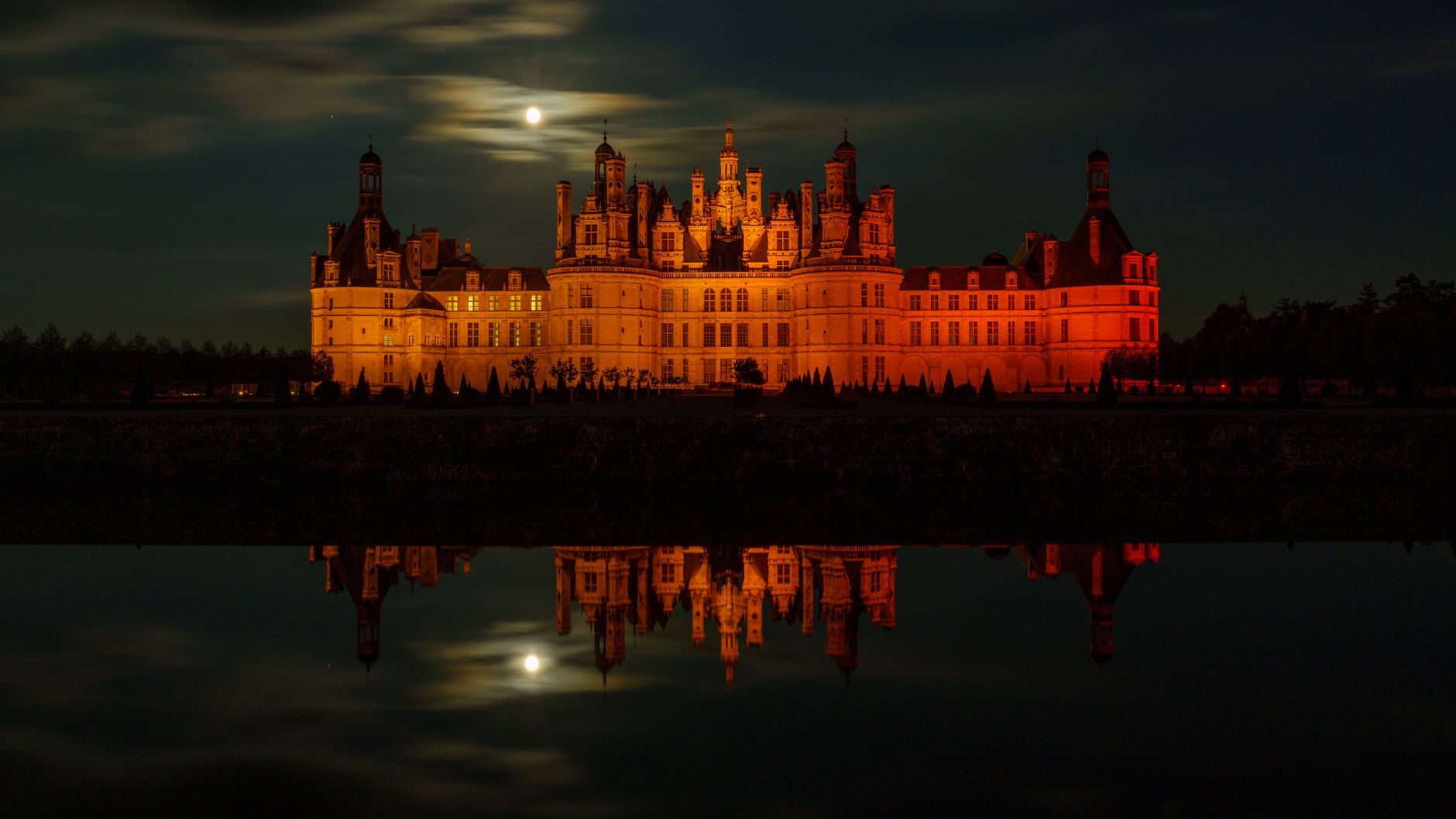
King François I began clearing the marshy floodplains of the Cosson river in September 1519, just four months after the death of Leonardo da Vinci. Fresh from his military triumph at the Battle of Marignano in northern Italy, the 24-year-old Valois monarch wanted something that would humble European rivals, particularly Holy Roman Emperor Charles V. He never intended Chambord as a practical residence. The estate was conceived as a theatrical hunting lodge and diplomatic statement where the royal court could stage hunting parties in autumn and move on.
Over his 32-year reign, François spent fewer than fifty total days here. Whenever the royal caravan departed, hundreds of carts hauled away the tapestries, velvet beds, folding stools, and silverware, leaving the vast limestone chambers cold and empty. Construction consumed substantial state revenues and required hundreds of stonemasons to drive thousands of oak piles into swampy ground to support the colossal foundation blocks.
The Double-Helix Staircase: Geometry and Leonardo's Hand
At the geometric heart of the central keep rises the double-helix staircase, the most celebrated architectural device of the French Renaissance. Two independent spiral ramps wind around a pierced, hollow stone cylinder, ascending through three floors to an open-air lantern tower. Two people can climb simultaneously - one starting from the courtyard side, one from the park side - without ever meeting or crossing paths. They hear each other through carved stone window slits and catch momentary glimpses, but their steps remain entirely separate.
While no signed engineering sketches by Leonardo da Vinci survive in the French royal archives, his presence hangs over every stone. Da Vinci spent his final three years at nearby Clos Lucé in Amboise under François I's payroll as "Premier Painter, Engineer and Architect to the King." His surviving notebooks (the Codex Atlanticus and Codex Arundel) contain detailed sketches of double-spiral hydraulic ramps and Greek-cross floorplans that match Chambord's internal geometry precisely.
Visiting Chambord from Paris Without a Rental Car?
Coordinating regional SNCF trains from Paris to Blois and catching the seasonal rural shuttle bus can be frustrating if timetables shift. The simplest option for seeing both Chambord and Chenonceau in a single day is an organized small-group day trip departing directly from central Paris.
The Greek Cross Keep and Royal Living Quarters
The interior layout departs sharply from medieval French defense castles. Each floor of the keep is arranged around a central Greek cross (four wide cross-vaulted corridors meeting at the staircase). Each corner of the cross holds a self-contained apartment suite consisting of a grand hall, a bedchamber, a dressing wardrobe, and a small study.
François I chose the north-east wing for his private royal lodging. Look up at the coffered stone ceilings: you will find more than three hundred carvings of the salamander, his chosen royal emblem, surrounded by tongues of fire and his Latin motto Nutrisco et extinguo ("I nourish the good fire and extinguish the bad"). Beside the salamanders sits the crowned initial "F" carved in delicate high relief.
Later monarchs attempted to make the draughty castle habitable. King Louis XIV stayed here on nine occasions between 1660 and 1685. Finding the Renaissance rooms freezing in autumn, he enclosed four corner rooms to create a royal apartment in the classical French Baroque style. It was here in October 1670 that playwright Molière premiered his satirical comedy Le Bourgeois Gentilhomme before the Sun King, with musical overtures conducted in the grand salon by Jean-Baptiste Lully.
In the 18th century, King Louis XV granted Chambord to Marshal Maurice de Saxe as a reward for his victory at the Battle of Fontenoy. To survive the bitter Sologne winters, the Marshal installed four massive blue-and-white Saxon ceramic stoves in the corner suites, allowing temperatures inside to reach a tolerable level for his stationed cavalry regiment.
The WWII Secret Sanctuary: Hiding the Mona Lisa
One of Chambord's most remarkable historical episodes occurred between 1939 and 1945. On August 28, 1939, as war with Nazi Germany became inevitable, French museum officials triggered a secret evacuation plan for the national art collections of the Louvre in Paris. In the dead of night, a convoy of cushioned trucks and a specially converted ambulance carrying Leonardo da Vinci's Mona Lisa (La Joconde) rolled through Chambord's gates.
For several months, the Mona Lisa was hidden inside Chambord's ground-floor vaults alongside thousands of masterworks, including the Venus de Milo and Delacroix's Liberty Leading the People. A dedicated team of French curators, led by Jacques Jaujard, lived in freezing, damp castle rooms without heating, guarding the crates and periodically relocating them deeper into southern France whenever German reconnaissance approached. Not a single major artwork stored within Chambord's walls was lost or damaged during the occupation.
The Rooftop Promenade: An Architectural Limestone City
Climbing past the second floor brings you out onto the wide stone terraces that surround the central lantern tower. The contrast with the stark lower walls is striking. Here, hundreds of dormers, gables, pinnacles, bell turrets, and 282 sculptured chimneys rise from the lead roofing. Henry James described this spectacle during his 1882 French journey as an "architectural forest."
François I had two motives for this elaborate roofscape. He wanted the roof to evoke the exotic skyline of Constantinople, showing French courtiers that Renaissance France could match eastern imperial grandeur. The wide terraces also allowed noblewomen and foreign ambassadors to follow stag hunts across the forest clearings below without descending into the muddy parklands.
Exploring the 5,440-Hectare Walled Forest Park
Chambord is surrounded by the largest enclosed forest park in Europe, covering an area roughly equivalent to inner Paris within the Boulevard Périphérique (5,440 hectares). A continuous 32-kilometer limestone wall encircles the entire property, broken only by six historic royal gates.
The inner formal gardens, restored in 2017 following archival plans from 1734, feature over 600 trees, 800 rose bushes, and four hectares of clipped lawns bordering the Cosson canal. Beyond the canal lies the wild forest reserve. While much of the reserve is protected to preserve red deer and wild boar breeding grounds, visitors can explore over 20 kilometers of marked trails. The best way to cover ground is to rent a bicycle (€8.00 per hour) at the canal dock or rent an electric club cart (€32.00 per hour). If you visit in late September or early October, head to the wooden observation hides along the Cosson at dusk to listen to the red deer stag rutting calls (*le brame du cerf*).
Red Flags and Mistakes to Avoid at Chambord
Direct Choice Visitor FAQ
Book a tour that combines both in one day, or choose Chambord for monumental exterior architecture and Chenonceau for furnished interior elegance. Chambord is vast, masculine, and largely unfurnished, showcasing colossal stone vaults and Da Vinci's staircase. Chenonceau spans directly across the River Cher with intimate, fully furnished bedrooms, working kitchens, and Old Master tapestries. If traveling with young children or mobility constraints, Chenonceau is much easier to navigate.
Yes, spend the €6.50 for the HistoPad if it is your first visit. Because François I left Chambord empty when the court moved, many rooms appear stark. The tablet's 3D augmented reality recreates the 1539 state visit of Emperor Charles V, showing exact furniture placements, crackling fireplace fires, and hanging wall velvets as you move through the rooms.
You can walk around the outer perimeter paths, village square, and view the exterior from across the canal without a ticket. However, walking inside the restored French formal gardens, ascending the double-helix staircase, and accessing the rooftop terraces requires an admission ticket (from €16.00 online). Admission is free for EU residents under 26 with a valid passport.
Allow a minimum of 3.5 to 4 hours. You need roughly 2 hours for the château interior, double-helix staircase, and rooftop terraces, 45 minutes for the formal gardens, and at least 45 minutes to walk along the canal or explore the village shops. If renting a bicycle to circle the park perimeter, add another 1.5 hours.
Why Book Your Tickets & Excursions Online in Advance?
While purchasing tickets on-site was standard in past years, the Loire Valley châteaux now enforce strict hourly visitor caps to protect historic interiors. High-demand hours (10:30–14:30) and weekends frequently sell out days ahead. Here are the key advantages of booking digital priority passes online:
Chambord Priority Tickets & Excursions (Viator & GYG)
Choose between independent priority mobile vouchers, on-site art historian walking tours, and full-day excursions from Paris.
Château de Chambord: Skip-the-Line Priority Entrance Ticket
- Bypass general ticket purchasing queues with instant barcode scan
- Full access to King François I's Renaissance palace and 400 rooms
- Ascend Leonardo da Vinci's iconic double-helix staircase
- Explore royal rooftop lantern terraces and 5,440-hectare walled park
Loire Valley Castles Day Trip from Paris with Wine Tasting
- Over 4,100 verified reviews: the most popular Loire day trip on Viator
- Skip-the-line entrances to Château de Chambord and Château de Chenonceau
- Guided wine tasting session with certified local sommelier
- Comfortable round-trip air-conditioned executive coach from Paris
Luxury Small-Group Wine & Castles Day Trip with Castle Lunch
- Strict limit of 8 passengers in premium luxury Mercedes minivan
- Private château tour and 3-course gastronomic French lunch with wine
- Exclusive tastings of aged Vouvray Chenin Blanc & Chinon vintages
- Dedicated art historian guide throughout the entire journey
Château de Chambord: Expert Art Historian Guided Tour
- Dedicated live English-speaking art historian guide
- Uncover Da Vinci's mathematical geometry behind the double-helix stairs
- Hidden symbols of François I (Salamander motif and secret royal emblems)
- Exclusive access insights into 16th-century hunting rituals
Chambord & Chenonceau Tour with Gourmet Lunch at Private Family Château
- Skip-the-line admissions to both Chambord and Chenonceau
- Exclusive traditional French lunch hosted at a private family estate (Château de Villesavin)
- Tasting of local Touraine and Cheverny AOC wines with host
- Small-group luxury minivan transport with passionate local driver-guide